When I Was Twelve, Part I.

When I was twelve, a drunk, older guy at a Jewel concert bumped into me and loudly exclaimed that I looked like Elizabeth Shue. I turned bright red and tried as hard as I could not to smile wide enough to reveal a mouth full of braces—I knew they’d undermine the intellectual, physical, and emotional maturity that he MUST have identified in me. (’Cuz nothing says maturity like scrawling “Eat Shit & Die” on your converse, stuffing your bra, and forcing your mother to sit ten rows behind you at The Wiltern and act like she doesn’t know you…but I digress.)

This man’s attention lit me up like a goddamn FEMA switchboard in a natural disaster, but he also made me feel so uncomfortable and so unsafe. This man didn’t see me. He couldn’t see me. And I knew it.

What I didn’t know and couldn’t have known at twelve was that this brand of cognitive dissonance—a paralyzing, simultaneous ignition of worthiness and worthlessness—would eventually become my emotional calling card. Welcome to womanhood, baby girl. Good luck making sense of anything that’s happening to you.

He asked for my [parents’ home] phone number; I gave it to him.

* * *

Today, as I pumped gas at the Monrovia Shell station, an embarrassingly bad, up-tempo Jewel tune of modest, early-2000s fame—God bless that woman’s second act—blared out of the speakers. And if Big Oil doesn’t believe we should occupy public spaces in silence, then neither do I, so I started singing along at full volume. Just as we hit the bridge (“…sell your sinnn; just cash innnn…”), I looked over my shoulder and caught the gaze of an older, mentally-disheveled lookin’ dude filling up his Mini Cooper.

He looked me up and down, hungrily licked his bottom lip, smiled approvingly, and said, “You remind me of Elizabeth Shue.” I immediately remembered that night in ’96 at the concert. Jewel! Elizabeth Shue! Creepy man! Same shit—how about that? I must have looked confused rather than surprised, because Mini Cooper man cackled—loudly enough to move him from the “mentally disheveled” to “mentally unhinged” category—and added, “Elizabeth Shue is from the 90s. Who knows what you were doing in the 90s.”

“This,” I said. “I was doing exactly this.”

Welcome to womanhood, baby girl. It only took twenty years to make sense of anything that’s happening to you.

He, too, asked for my phone number; I didn’t give it to him.

img_3752

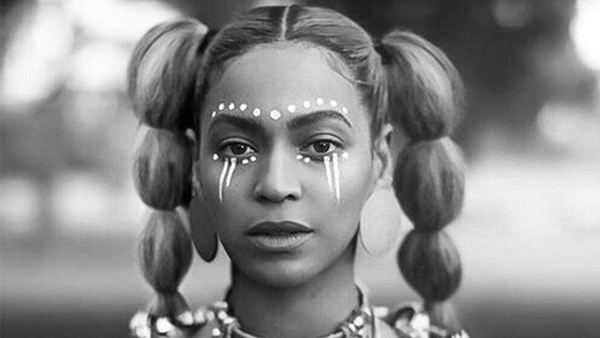
Why Beyoncé’s LEMONADE is Everything.

beyonce-lemonade

If you haven’t watched (and please watch it—don’t just listen to it) Beyoncé’s LEMONADE yet, read Bené Viera’s piece below first. If you have watched it, read it now.

This album is a big deal. And it’s not a big deal—or a bunch of consumers deluding ourselves into “thinking” it’s a big deal—just because it’s a Beyoncé album. Mark my words, this isn’t a case of an artist’s own hype duping the masses into false reverence.  If you’re convinced that this is only a big deal because its lyrics shovel a new heap of gasoline-soaked coal into the ol’ gossip furnace (“Did he really cheat?!”), you would also be wrong.

LEMONADE is a big deal because it is this exact album and because Beyoncé is the vehicle for it.  You cannot separate one from the other here; as McLuhan told us decades ago, the medium is the message.  It is an album rife with commentary about femininity, masculinity, blackness, betrayal, vulnerability, uncertainty, and spirituality as performed by an international megastar who happens to be as cross-culturally embraced for her beauty, poise, and total reserve as she is for her talent.

LEMONADE is a big deal because it marks a key cultural moment. It tells stories that have been told before, sure—but not told like this.  Not all at once.  Not by Beyoncé.  And, like it or not, this matters.  LEMONADE is pop art that reminds us that, in spite of ourselves, we are living through an important cultural shift.

I could write so much more, but even though I absolutely knew what “call Becky with the good hair” meant without Googling it, I’m gonna go ahead and put my pen down, per Ms. Viera’s request.

ok

I Used to Write Poems

I used to write poems.  

I always thought it was dumb to write poems.

I still think this.

I should probably write poems again.

* * *

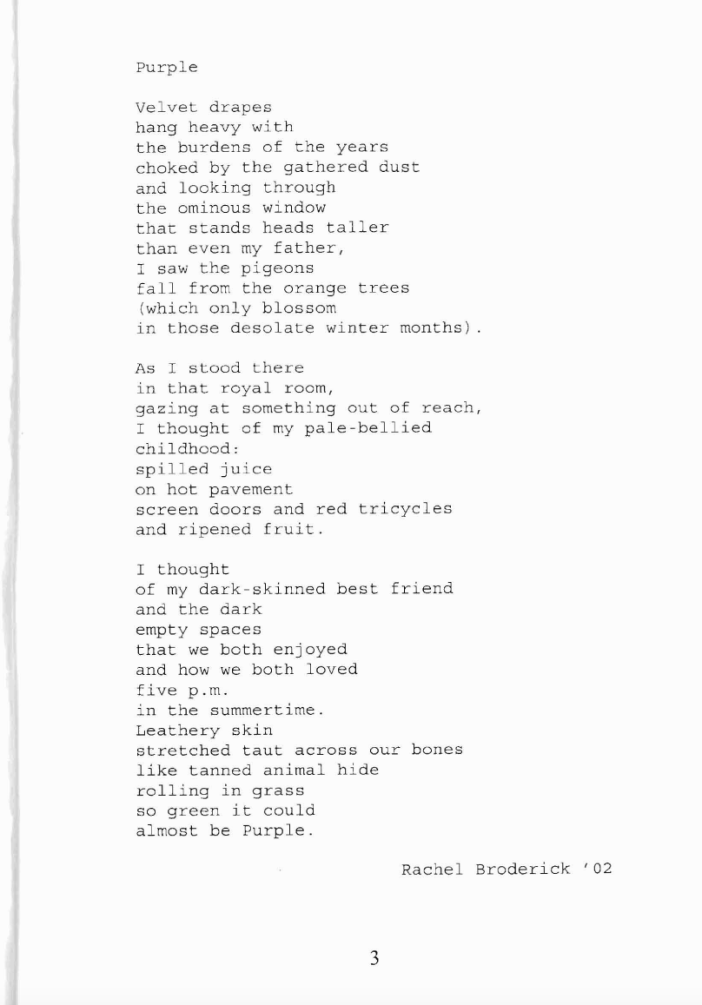
Purple.

For almost a decade, I have been searching for a copy of a particular poem I wrote when I was fourteen.  I hadn’t been able to remember if it was actually any good or not, but I remembered everything else about it and around it.  I have been piecing together lost moments of lost years lately, and somehow, finding this poem became critical. An obsession.

I remember writing it.  It still feels so recent and familiar—sitting in the Main Hall computer lab at my all-girls school, eating shitty vanilla-cream sandwich cookies from the snack machine while furiously typing every line that danced out of my achey little heart.  It was a soul dictation.  An angsty, adolescent soul dictation written during the last twenty minutes of a lunch period and due to be placed in Judy Chu’s hot little hands by the end of the day.

Ms. Chu was my 9th grade English teacher.  She loved my writing.  I loved her for loving my writing.

* * *

Jump cut to 10th grade.  Now I’m sixteen.  I’m sixteen, and I’m wearing my skin inside-out.  I’m so raw and exposed that a passing breeze can light my nerves on fire.  I feel everything, and all of it hurts. I don’t show up when I’m supposed to, and I rarely turn in my homework.  Because I fucking can’t.

Instead, I’m drinking and smoking and using and bingeing and starving and crying.  Crying, crying, crying.  All the time.  The Big Feelings had established their roots in my limbic system years ago (7th grade? 8th grade? hard to say), and by 10th grade, they had swallowed me whole.

So when my final poem is due in Ms. Lipschutz’s creative writing class, I dig through my archives.  Because at this point, if I do turn in my homework, you’re either getting copied answers or recycled assignments from brighter days gone by.  Sorry, but what do you want from me?  I’M ON FIRE.  This is the best I can do.

I find the poem.  The 9th-grade-Main-Hall-computer-lab poem.  “Purple,”  I had titled it.  I have no memory of that title or of the poem, but I turn it in and pass it off as new material.  And Ms. Lipschutz likes it.  Her sweet, rubbery face lights up when she reads it aloud a second time for the class.  What a strange lady, I think.  I fall asleep on my desk.

The school year ends, I am stuffed to the gills with SSRIs, and I hate myself more than ever. I am not sober.  I attend all of the end-of-year ceremonies that seem to be de rigueur at girls’ schools.  There is always a piano processional and polite clapping at these ceremonies.  And I always smile and polite-clap for as long as I can, or until I’m swept away by the undertow of my own, ever-present shame and taken elsewhere.

Shame has always done that to me.  My heart races, the abusive thoughts get louder and more intrusive, and then, without warning, all frequencies turn to static, drowning out everything around me and lulling me into a fantasy world.

I’m at one of these end-of-year ceremonies, watching all of the shiny pennies collect their awards and accolades.  The deafening, internal refrain of, ‘You are a total fuck-up; you will never be happy,’ is about to reach fever pitch and give way to the static.  I can feel it.  But I am jolted back into the moment by the Head of School calling Rachel Abelson to the stage to present the latest edition of Outlook, the annual student-run literary journal.

Rachel Abelson is a class-of-2000 senior, the co-editor of Outlook, and the best writer I have ever known in real life.  She is tall and complicated.  She has enviously large breasts and unapologetically cold, blue eyes.  She wears Doc Martins and vintage sweaters with our required school uniform pants.  (We are also allowed to wear uniform skirts, but Rachel always wears pants.)  Her hair is often messy.  She barely speaks, and when she does, she speaks with purpose.  Most importantly, Rachel Abelson is exactly who I want to be.

Rachel’s writing is so sharp and nuanced and original that it makes me sick with jealousy.  Once, in a poem, she described her vagina as “that Saturn sunset just below my dust-bunny navel” or something like that.  I’m sorry, but what 17-year-old comes up with shit that good?  It’s not even fair.

She has probably already had sex, I thought when I heard that line for the first time.  She is just too fucking good.

Anyhow, Rachel takes the stage, thanks the Head of School, and coyly tells the audience that she and the Outlook staff believe that the new millennium is going to mark an incredible epoch in modern literature.

“As evidenced by the works produced by the young writers in Ms. Lipschutz’s classes this  year,” Rachel declares, “the literary world should brace itself for something exciting and incredible.”

A lofty claim, I think to myself.

She continues, “To give you an idea of what we all have to look forward to, the editors of Outlook would like to read one of our favorite submissions this year, written by an extraordinarily gifted and talented member of the class of 2002.  This is ‘Purple’ by Rachel Broderick.”

And with that, Rachel Abelson reads my poem.  What. The. Fuck.  Rachel Abelson—who I worship and who has never spoken a single word to me—reads my poem.

Everyone claps.

My parents are in the audience somewhere.

Maybe they are all just polite-clapping.  I don’t know, and I don’t care. Because for the rest of that afternoon and pieces of the days following, I do not hate myself.

* * *
 

Screen Shot 2016-04-14 at 11.34.07 AM

Broad Highway

IMG_6915

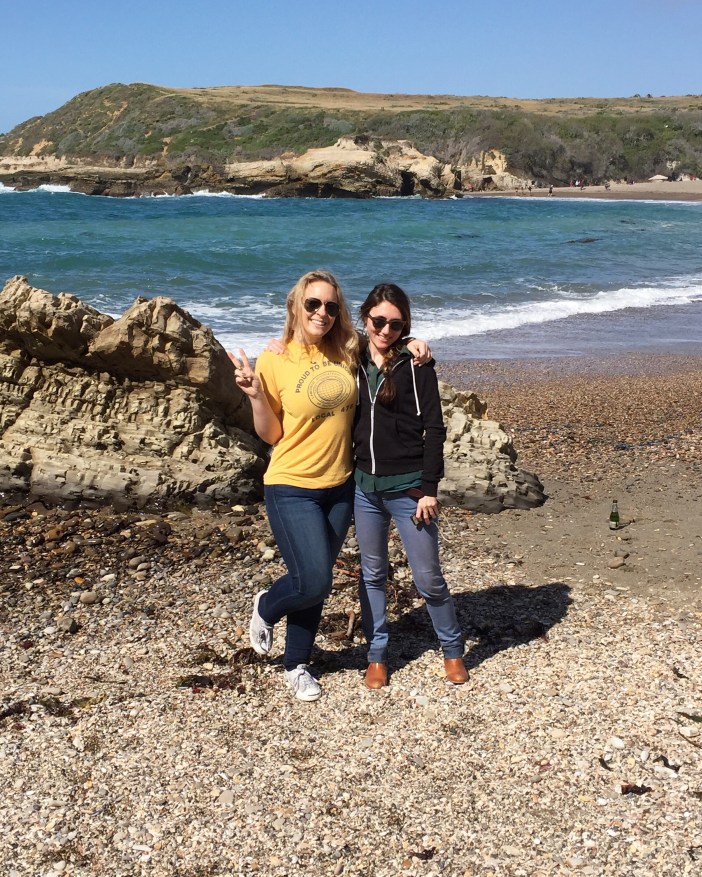
I’m sitting here on my all-too-short lunch break, dreaming of the magical Central Coast. I had such a perfect, peaceful weekend with my lady friends at the Madonna Inn (#bucketlist), dear reader, and I’m feelin’ mighty reflective.

Listen, if you’re reading this right now and happen to be in a dark place, I get it—I’m sure you’re just fucking TICKLED that I had a perfect, peaceful weekend. Delighted, even. I know, and I’m sorry. Even still, this feels important to share. Because I DID have a perfect, peaceful weekend, and feeling peaceful is still pretty darn novel to me.

I’m not trying to get all Anne Lamott on your ass (mad love to you always, Anne), and I certainly don’t think that I’m the first person to emerge from a dark place with a little tale to tell, but I do think that our stories are important. They’re not just important—they’re everything. Sharing our stories of who we are with each other is the most powerful way that we connect as human beings—and as far as I’m concerned, that’s really all we’re doing here on planet Whatever. Connecting. Trying to connect. Failing to connect and then trying again.

I’m not even saying that I’m any good at it. I’m fucking not. I’m still a bit awkward, a bit detached, a bit dissociated, a bit guarded. All of that. I’m all of that. I’m just saying that I’ve been doing the fucking work. I’ve been doing so much schlepping and heavy lifting that, at some point, I stopped realizing that’s what it was. All of it—the writing, the truth-telling, the digging, the rearranging, the discarding—it just became what I do. Somewhere along the line, what started out as a sweaty-palmed, heart-racing scramble to survive (and I swear to God there were days where it felt like my lungs were filling with water) became a steady walk.

Love doesn’t happen when you stop looking for it; love happens when you have made space for it.

***